 When one traces the history of the Cursillos in Christianity Movement in Argentina, one discovers a story that did not begin suddenly, but rather developed in stages, with advances, setbacks, and decisions that marked its course. As in many ecclesial processes, nothing was linear; there were attempts that did not prosper and beginnings that, seen from a distance, functioned more as preparation than as immediate achievements.
The first attempts in Buenos Aires (1958)
At the end of 1958, a small group of Argentine lay people returned from Spain with an undeniable enthusiasm for the Cursillos experience. Juan Vázquez, Héctor Pérez, Eduardo Madero, and José Garralda arrived in Buenos Aires convinced that the Movement could also take root in their country. They had become familiar with its methodology, spirit, and pastoral impact.
However, the initiatives they promoted during those months failed to take hold. They lacked what, in the history of the MCC, has been decisive everywhere: the mindset of Cursillo and its structured method, which is not a series of techniques but a way of understanding the evangelization of people in their environments. That initial enthusiasm was not enough, and the first Cursillos held in Buenos Aires did not continue or bear fruit.
The protagonists themselves and later tradition would call this period the “zero era”: an attempt that did not simply disappear, because it left behind experience and questions, but which did not become the real beginning of the Movement in the country.
Tucumán: the real starting point (1961–1962)
The actual history of the MCC in Argentina begins far from the capital, in the diocese of Tucumán, around 1961. There, a key figure appears: Juan Salsenser, a layman who, for work reasons, had arrived from Spain with the experience of the Cursillo fresh in his memory. Salsenser began to share his experience with Catholic Action leaders, who received his concerns with interest.
In this environment, the figure of Father Joaquín Cucala Voix, parish priest of Montserrat, also emerged. He understood the potential importance of the Cursillos and decided to travel to Spain to study their methodology and spirit firsthand. His support and vision were fundamental in this initial stage.
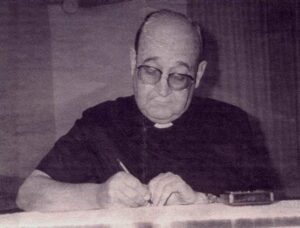 In 1961, another decisive person joined the group: Father José Ricardo Arbó, a Spaniard by birth, ordained a priest in Argentina, who had experienced his own Cursillo in Gerona in 1958. Arbó, remembered today as one of the founding figures of the Argentine MCC, offered his collaboration and for a time worked alongside Father Cucala and the group of lay people. However, a change soon took place: Cucala was unable to continue leading the project, and with his consent and the bishop’s permission, Arbó took on the responsibility of organizing the first Cursillo.
The preparation was meticulous. Arbó himself, many years later, would say that those months were lived with “a lot of work and a lot of perseverance,” and that the spirit that guided them was the conviction that the Cursillo had to be faithful to its essence in order to bear true fruit.
Finally, the First Cursillo of Tucumán culminated on July 9, 1962, with the active participation of priests Delfino Sánchez and Vicente Zueco. That date can undoubtedly be considered the real birth of the Movement in Argentina.
The sustained leadership of Father Arbó
From that moment on, Father Arbó became a permanent reference point for the MCC in Tucumán and, to a large extent, in the country. His testimony—conscious, balanced, and deeply faithful to the charism—marked a way of living the Movement that remained for decades. His constant presence at numerous Cursillos and his service in various secretariats made him a true pastoral driving force for the growth of the MCC.
Córdoba: expansion backed by experience (1964)
A second important milestone occurred in 1964, when the MCC arrived with force in the diocese of Córdoba. On July 9 of that year, Father Carlos Zelarayán arrived from Caracas, sent at the suggestion of Father Cesáreo Gil, who had convinced the Archbishop of Córdoba of the pastoral benefits of the Cursillos.
Zelarayán, with extensive experience in Venezuela, immediately began preparations for the first Cursillo in Córdoba. To this end, he invited Venezuelan leader Alberto Silva Guillén to be the rector and called on leaders from Tucumán to complete the team.
Between August 14 and 17, 1964, the First Cursillo of Córdoba was held, and its results were so markedly positive that within a few weeks four more were scheduled: two for men and two for women.
That same year, from October 30 to November 2, the First Women’s Cursillo in Córdoba was also held, with the participation of Father Zelarayán as spiritual director and a team of women from Caracas, led by Gladys Baraja.
The MCC spreads throughout the country (1966 onwards)
From Tucumán and Córdoba, the Movement began to expand to other dioceses. Buenos Aires resumed the experience in March 1966, now on a solid foundation, and Rosario celebrated its first Cursillo in October of the same year. From there, the MCC multiplied progressively, consolidating structures, teams, and mentality in various regions of the country.
What is remarkable about this process is that it was not an artificial or programmed expansion, but rather the way in which Cursillos usually grow: by contagion, by testimony, by human relationships. Wherever a group lived the experience authentically, the desire to share it arose.
Current situation
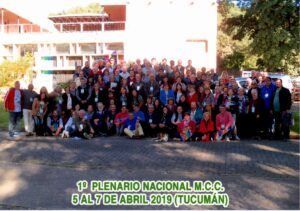 Today, several decades after those first steps, the MCC is present in 65 dioceses in Argentina, out of a total of 73 ecclesiastical circumscriptions. It is a widespread, recognized movement with a rich history of protagonists, searches, challenges, and pastoral fruits.
A process that continues
Looking at the history of the MCC in Argentina allows us to recognize the importance of the fidelity of its early figures, its roots in the diocese, the formation of teams, and its respectful adaptation to the local context. It was a process that was not without difficulties, but it grew because it maintained—in its best moments—the essence that gave rise to the Movement: the kerygmatic evangelization of the person through the power of friendship and community witness.
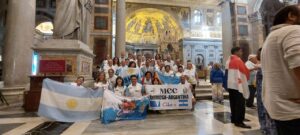 The 21st century presents us with many challenges, with its new paradigms.
From its charism, Cursillos in Christianity has responded since its inception to the synodal church’s call to walk together, proclaiming as witnesses that “God in Christ loves us.”
It is a path that must be lived and built with an eye to the future…this requires of us, the Cursillistas, different attitudes: breaking paradigms, discerning, evaluating, correcting with creativity and faith.
We want the Cursillo Movement in Argentina to continue to grow, through synodal men and women who, with their joy and friendship, will ferment their environments to change reality. In this way, many more people will find the true meaning of life and fulfillment as God dreams it.
De Colores.
Photos taken from the S.N. Argentina website.