
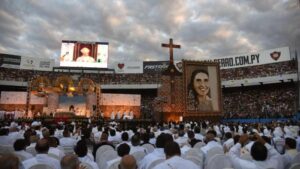
 To speak today of the Church in Paraguay is to speak of a deeply devout people, where faith is not merely a tradition, but a way of life. In a land where more than 88% of the population identifies as Catholic, the Church continues to have a face that is approachable, down-to-earth, and deeply rooted in everyday life. It is not a faith confined to an office, but one of family, of community, of simple devotion—such as that which surrounds the Virgin of Caacupé—and, at the same time, a faith called to constantly renew itself in the face of the challenges of today’s world.
In this context, the Cursillos in Christianity Movement found fertile ground in Paraguay, a willing heart. For when the Gospel encounters an open people, what St. Paul foretold comes to pass: “Woe to me if I do not preach the Gospel”. And Paraguay, in a way, was waiting for that proclamation.
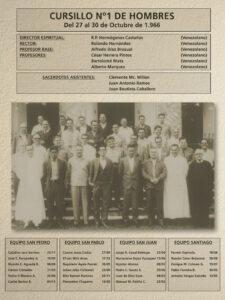 Thus, from October 27 to 30, 1966, in La Piedad, the first Cursillo de Cristiandad in Paraguay was held. The first men’s Cursillo. Those days were not merely an event, but the beginning of a story of conversion, friendship, and community. The following week, the second Cursillo reaffirmed that this was no passing fad: the Holy Spirit was at work with great power.
Behind that beginning are specific names, but above all, there are dedicated vocations. Father Clemente McMillan, a Redemptorist, emerges as a key figure, a docile instrument in God’s hands. His dedication, his apostolic zeal, and his fidelity made it possible for the MCC to take root. It is no coincidence that today the Cursillo house in Puente Remanso bears his name: a living memory of one who knew how to let himself be used by Grace.
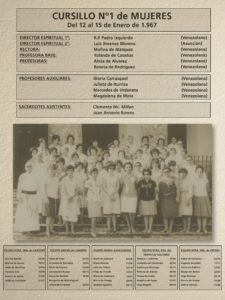 But the MCC, when it is authentic, does not remain limited to a few. Soon those first men felt the need to share what they had experienced with their wives. Because an encounter with Christ cannot be contained; it expands, it spreads, it is communicated. And so, in January 1967, the first women’s Cursillos arrived, with the generous help of Venezuelan brothers. History repeated itself: dedicated teams, careful selection, abundant results.
Little by little, Paraguay ceased to be a mission land and became a missionary land. Beginning with the fifth men’s Cursillo and the fourth women’s Cursillo, the Paraguayan leaders themselves took on the responsibility. The charism had taken root. It was no longer something imported: it was a life of its own, incarnated in its people, in its culture, in its Church.
Just as in the early days of the Church, when communities were taking shape and structure—as the Acts of the Apostles recount—so too in Paraguay did the Secretariats emerge. First the Archdiocesan Secretariat, led by Carlos Berino, and later, in 1969, the National Secretariat. Not as a bureaucracy, but as a service: to coordinate, animate, and sustain. Because where there is life, order is needed; and where there is charism, fidelity is needed.
By then, 35 Cursillos had already been held in the country. Thirty-five personal encounters with Christ. Thirty-five small communities being born. Thirty-five stories of transformed lives. It was clear: the MCC was not just another experience; it was a path.
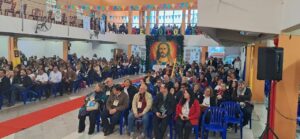 And that path has not stopped. In recent years—2023, 2024, 2025—more than 2,400 men and women have experienced their Cursillo in the 12 dioceses where the Movement is present. We are not talking about numbers, but about people. About concrete stories. About perspectives that change. About environments that begin to transform from within.
Because that is the deep intuition of the MCC, so in tune with St. Paul: to evangelize environments. Not from the outside, but from within. Not by imposing, but by proposing. Not with speeches, but with life.
And so, step by step, Ultreya by Ultreya, the Movement has been weaving an invisible network of Christian friendship throughout Paraguay. A network that sustains, that encourages, that sends forth. A network where every Cursillista discovers that they are not walking alone.
On October 25, 2026, when more than 5,000 Cursillistas gather at the 31st National Ultreya in Asunción to celebrate the 60th anniversary of the MCC in Paraguay, they will not be celebrating just another anniversary. They will be celebrating God’s faithfulness. Because if this history teaches us anything, it is that when the Lord begins a work, He sustains it.
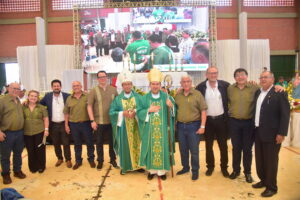 Sixty years later, the MCC in Paraguay remains what it has always been: a joyful proclamation of the Christian essentials. A living reminder that Christ continues to go out to meet humanity. And that, as St. Paul said, “I can do all things through Him who strengthens me”.
Today, as yesterday, Paraguay continues to hear that proclamation. And it continues to make it its own.
¡De Colores!