
There are realities in the Church that cannot be explained solely by organization, nor by planning, nor even by pastoral effectiveness. They are the work of the Spirit. And when the Spirit blows, He does so with a freedom that surprises, overflows, and bears fruit beyond any human foresight. This is what has happened with the Cursillos in Christianity Movement.
From those first simple and bold steps, the Cursillo method—that kerygmatic, experiential proclamation centered on the person of Christ and transmitted through friendship—has been generating life. And life, when it is authentic, multiplies. It does not repeat itself: it takes on flesh, adapts, and recreates itself. And so, without losing its essence, it has given rise to a veritable constellation of initiatives, movements, and experiences throughout the Church.
 The first thing that strikes one is its universality. The Cursillo method has been welcomed, embraced, and adapted by many Christian denominations. From the Anglican Cursillo, present in numerous countries, to expressions such as Camino, Via de Cristo, or the Way of Emmaus, through ecumenical initiatives such as Koinonia, Tres Días, or Great Banquet, all of them share the same heartbeat: the proclamation of the Christian essentials lived in community, with a clear before and after, with a “fourth day” that drives the transformation of environments.
This is no coincidence. As the Magisterium points out, the Holy Spirit stirs up charisms in the Church for the building up of the Body of Christ (cf. Lumen Gentium, 12). And when a charism is authentic, it does not remain closed in on itself, but becomes fruitful. Cursillos, in its simplicity, has offered the Church a method that places the essential at the center: the personal encounter with Christ, the communal experience, and the apostolic mission.
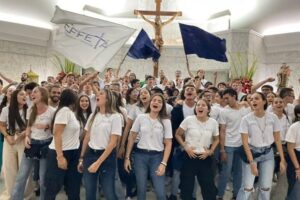 But this fruitfulness is not limited to geographical or denominational expansion. It is also manifested in the ability to reach different ages and realities. In a special way, its fruitfulness among young people is striking. Movements such as EPJ (Encuentros de Promoción Juvenil), Chrysalis, Happening, Vida Nueva, TEC, or Arcoíris have been able to translate the very core of Cursillo into the language and concerns of young people.
In all of them, a deeply Cursillista intuition is repeated: it is not about transmitting ideas, but about provoking an encounter; not about filling the head, but about igniting the heart; not about forming spectators, but apostles. Young people who discover that Christ loves them, that their lives have meaning, and that they are called to be leaven in their environments. Exactly the same strategy that inspired the first Cursillos.
And perhaps where the authenticity of the charism shines most brightly is in its ability to take root in concrete realities, often wounded or marginalized. There we find initiatives such as Kairos in prisons, Credo Recovery for people in rehabilitation, Cursillos for the deaf, or initiatives adapted to specific cultures like Canku Wakan.
Here the method reveals its full power: it is not rigid, it is not uniform, but it is faithful to what is essential. Wherever there is a person, there can be an encounter with Christ. Wherever there is a community, there can arise a small community that transforms it from within. As the Second Vatican Council reminds us, the Church is called to “discern the signs of the times” (Gaudium et Spes, 4), and Cursillos has known how to do so through closeness, friendship, and trust in grace.
 Because, at its core, all of this is nothing other than the unfolding of a single insight: that Christianity is something simple, profound, and contagious. That when a person truly encounters Christ, their life changes. And that when that life is shared, it becomes a seed.
Perhaps that is why what has been repeated so often in the Movement remains so relevant today: that Cursillos is not an end in itself, but a means. A means at the service of the Church, so that more men and women may discover that God loves them.
Today, as we contemplate this impressive fruitfulness—in so many denominations, in so many countries, in so many human realities—we cannot help but give thanks. Because what began as a small seed has borne abundant fruit. And it continues to do so.
As the Gospel says: “By their fruits you will know them” (Mt 7:16).
And the fruits are there. Alive. Joyful. On the move.
De Colores.