 When asked what blasphemy against the Holy Spirit consists of (Luke 12:10), Don Luigi Maria Epicoco shows the splendid landscape that can be seen from the window of his study and, when the interlocutor expresses his admiration, comments: “That beauty is there even if I am a sinner or the best of saints. That beauty is there, but it does not impose itself on my gaze. In fact, I could look out of that window and keep my eyes closed.“ He adds: ”That is what blasphemy against the Holy Spirit is: standing before the Light and stubbornly keeping your eyes closed. That darkness, deliberately chosen by me, cannot be forgiven because God’s mercy cannot force me to open my eyes.”
With this issue of our magazine, we are also opening a new year of activity for our Movement. At the national assembly in October, we recognized many positive signs: a reawakening of enthusiasm and a desire to participate, the seeds of new ways of living the Cursillo and evangelizing with the wonderful tool that the Holy Spirit has given us through the courage of Eduardo and those who accompanied him. It is thanks to this openness to the action of the Holy Spirit that the Movement has spread across five continents, bringing to people of every age and every place the good news that God, in Jesus Christ, loves them personally, one by one, whether they are sinners, people on a journey, or already saints. We experienced this firsthand at the World Ultreya in June 2025, where we felt truly united by the same charism, despite our rich diversity.
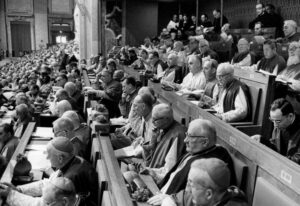 When, more than eighty years ago, this inspiration was born in Eduardo’s heart and matured, thanks to prayer and intelligence, into his deepest conviction, if he had thought that giving all this importance to the laity had never been done before, that priests knew how to evangelize and therefore it made no sense to introduce a new modality into the pastoral ministry of the Church, that in the millennial history of Christianity it was not common practice for the laity to proclaim the Gospel, would we be here today talking about Cursillo in Christianity? Almost certainly yes, because the Holy Spirit would have inspired this new development in another heart ready to serve him. But Eduardo did not allow himself to be stopped by the social, cultural, political, and religious conditions of the time. With his “here I am,” he paved the way for many innovations, which the Second Vatican Council then made its own. He listened attentively and respectfully to the comments addressed to him, remaining silent when necessary, but never deviating from what the Holy Spirit had inspired him to do.
This is where blasphemy against the Spirit lurks for us Cursillistas today: thinking that He blew once and for all and then withdrew from history, so that we are forced to slavishly repeat what began eighty years ago without demonstrating our ability to translate (without betraying).
Sometimes differences in mentality or generational differences create tensions that overshadow the atmosphere of friendship that should characterize our journey together. This is understandable: when we care about something, we can all become cautious, defensive, and sometimes a little rigid. But precisely because we share such a precious charism, we are called to go beyond these limits, to learn from one another, and to support one another in change.
 The Movement is called today to take a step forward, not to deny the past, but to be faithful to it. For this reason, it is important to avoid regulations becoming a tool to curb initiatives that could bear fruit; bureaucracy limiting the growth of young people; customs born in other historical contexts becoming absolute criteria; and some people being discouraged from participating in the three days for reasons that are not really essential. Sometimes, without meaning to, we risk applying criteria that exclude rather than welcome.
The National Coordination has proposed a document that calls for maximum openness and the broadest possible inclusion, reminding us that charity and mercy must inspire our choices. It is a valuable reminder, which does not aim to correct anyone in particular, but to guide everyone towards a more evangelical style that is more consistent with our Charism. If some words resonate as a personal provocation, they can become an opportunity for growth and discernment. Not to judge, but to build together a more peaceful, fraternal, and transparent climate.
Continuing with the logic of “letting go,” hoping that situations will resolve themselves, is no longer acceptable today. We must open our hearts to the breath of the Holy Spirit who calls us to be attentive to the times in which we live, ready even to give up our securities, in order to respond to the anxieties and sufferings of those around us.
A parent told me in front of the schools where I take my granddaughter: “We talk a lot about saving the environment, but we need to focus our goal better; we need to save humanity!” It is the person, with their thirst for daily and eternal happiness, who must be close to our hearts, who awaits a response.
Does this seem like too big a goal? Perhaps. But Cursillo has proven for decades that it has extraordinary power. Hearts change one at a time, with patience and friendship, and if we finally choose to be courageous, to come out into the open, to be the first to untie the inner knots that hold us back, then yes, we can truly contribute to a brighter and more engaging Movement, to a broader and more welcoming Church, to a more just and peaceful world.
“God has given us the happiness of understanding that it is a joy—as much as this may be annoying—to live in such an extraordinarily difficult time of ascent,” said Bonnin, inviting us to climb the mountain of life together!
Carlo de Benedetti
National Coordinator of MCC Italy