The history of the Cursillos in Christianity Movement in Hungary did not begin with a large public event or an established structure. It began with people crossing a border carrying little more than notes, addresses and the desire to share an experience that had changed their lives.
In the Hungary of the early 1980s, the Church still lived under the scrutiny of the communist state. In that setting, a movement centred on friendship, freedom, a personal encounter with Christ and the transformation of environments opened an inner space that political control could not easily reach. The history of the MCC in Hungary is therefore also a history of patient perseverance.
A sowing before the first Cursillo
The year 1989 is often cited as the beginning of the MCC in Hungary, because that was when the first Cursillo was held on Hungarian soil. Yet the sowing had begun seven years earlier. From 1982 onwards, Hungarians living in Austria tried to make the movement known among relatives, friends and Catholic communities in their country of origin. Péter Mészáros was one of the key figures in those early contacts.
The path was far from simple. The authorities delayed or obstructed meetings, copied or confiscated notes, searched travellers and even dismantled cars at the border. Places that had agreed to host gatherings sometimes withdrew at the last moment. What looked like a modest spiritual initiative was viewed with suspicion because it created free bonds of trust between people.
In 1986, István Vichnalek, his wife Marika and other Hungarians attended a Cursillo in Vienna and then continued their formation. They became the nucleus of the first committed Hungarian team. An attempt to organise a Cursillo at the Benedictine Abbey of Pannonhalma was stopped by the State Office for Church Affairs. The movement’s history in Hungary thus began not with expansion, but with waiting, preparation and fidelity.
1989: the first Cursillo on Hungarian soil
The first men’s Cursillo in Hungary was finally held from 13 to 16 April 1989 in Iszkaszentgyörgy, near Székesfehérvár. Most participants came from Budapest, and the team received decisive support from Vienna. Among those who helped were Edina Bogláryné Mailáth, the Jesuit Antal Benkő and the Claretian missionary José García Cascales.
The first women’s Cursillo followed at the same place from 22 to 25 June. This explains why the sources sometimes mention 1982 and sometimes 1989: the first date marks the beginning of the sowing; the second, the first full Cursillos held inside the country.
A first coordinating body was formed in 1990. In May 1991, Hungarian representatives were already taking part in a meeting of European secretariats in Vienna. A movement that had entered quietly through personal relationships was beginning to find its place in the wider European family.
Two paths that eventually met
A second centre of expansion emerged in Szombathely in 1990. There, Hungarian Cursillistas from Canada collaborated with the Jesuit Jenő Bóday and the Divine Word missionary Jenő Gaál. From this western region the experience spread towards Veszprém and Győr.
The MCC did not grow according to a strategy designed at a desk. It grew through friendships, journeys, invitations and personal testimony. Communities gradually appeared in Pécs, Eger, Debrecen-Nyíregyháza, Hajdúdorog, Kalocsa-Kecskemét, Kaposvár, Szeged-Csanád, Vác and Székesfehérvár. The movement took root in both the Latin and Greek Catholic traditions. In February 2000, the first Greek Catholic Cursillo was held at Máriapócs.
From a receiving country to a missionary community
Hungary soon began to share what it had received. From 1991 onwards, the community in Esztergom-Budapest helped bring the MCC to Transylvania. Later, Hungarian Cursillistas also accompanied the movement in Transcarpathia and in other places where Hungarian-speaking communities lived.
The borders that had once been obstacles became paths of mission and communion. This is one of the most beautiful features of the Hungarian story: the same frontier that had been crossed with caution during the communist years later became a bridge for evangelisation.
The experience also reached Reformed Christians. The first Hungarian Reformed Cursillo was held in 2005, and the initiative subsequently expanded in Hungary, Transylvania, Transcarpathia and Slovakia. By 2020, its organisers reported that more than 5,000 people had taken part. This ecumenical development did not erase confessional differences. It showed, rather, that the proclamation of God’s love can open honest spaces of encounter among Christians.
Eduardo Bonnín’s visit
In 1997, at the age of 81, Eduardo Bonnín visited Budapest. His presence coincided with the first National Assembly of Elders and with the creation of a national coordinating group led by László Felföldi.
The visit had great symbolic force. A charism born in Mallorca after the Second World War had reached a country that had spent decades behind the Iron Curtain. Bonnín’s presence reminded the Hungarian community that the Cursillo was not simply a method that could be imported, but a living way of friendship, conversion and evangelisation.
In July 2000, around 250 Hungarian and Transylvanian Cursillistas took part in the Third World Ultreya in Rome, where they met Saint John Paul II. Hungary was no longer only receiving the movement; it was becoming visibly part of its world community.
Growth, organisation and new environments
According to the Hungarian Catholic Lexicon, 193 Cursillos were held in the country between 1989 and 1999, with approximately 5,100 participants. In February 2009, close to a thousand people gathered for the First National Ultreya, celebrating the twentieth anniversary of the first Cursillo on Hungarian soil. As with every historical count, the figures vary slightly according to the dates and categories used, but they clearly show the speed and breadth of the movement’s growth.
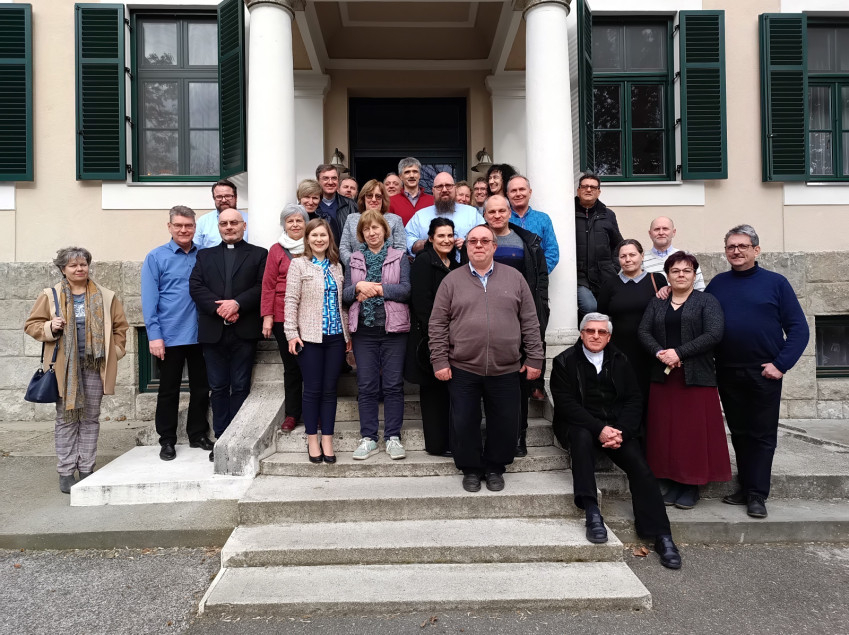
In 2015, the National Secretariat received a more formal structure. Bishop János Székely played an important role in the movement’s spiritual accompaniment. Organisation was necessary, but it remained at the service of the central purpose: enabling people to discover that God loves them and helping them live that discovery in their everyday environments.
The MCC also sought out environments that are easily forgotten. A prison Cursillo was organised in 2014, and in 2015 an experience was held specifically for members of the Romani community. These initiatives expressed a simple conviction: the love of God is not intended for a closed circle, but for every person, especially where loneliness, exclusion or hopelessness are strongest.
Hungary at the service of the European MCC
In 2023, Hungary assumed the service of coordinating the European Group of the Cursillos in Christianity Movement (GECC) for a four-year term. Judit Várdai became president, accompanied by a Hungarian team. European representatives met in Budapest and Esztergom to mark this transition.
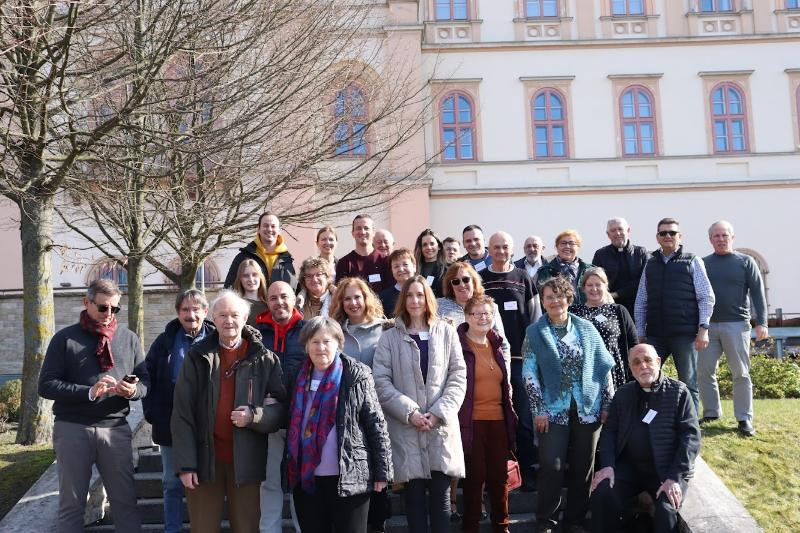
The gesture completed a remarkable historical arc. A country that had once depended on the courage and generosity of Cursillistas from Austria and Canada was now being entrusted with a service of European communion. What had been freely received was now freely shared.
A history shaped by perseverance
The history of the MCC in Hungary cannot be reduced to a sequence of dates. Its deepest lesson lies in the people who continued when venues withdrew, when border searches made every journey uncertain and when there was no guarantee that their efforts would bear fruit. They went to Vienna to be formed, returned home, built friendships and, in time, crossed other borders to accompany new communities.
The movement entered Hungary through friendship. Its later structures, assemblies and secretariats served communion, but they could never replace the essential gesture: one person communicating to another, through life rather than slogans, that God loves them.
Seven years passed between the first sowing and the first Cursillo on Hungarian soil. Decades later, Hungary accepted responsibility for serving the European MCC. Between those two moments lies an entire school of perseverance. Ultreya means moving forward, but the Hungarian story adds something important: moving forward also means trusting that the seed belongs to God, even when its growth cannot yet be seen.
De Colores!
Sources consulted
- Budapest Cursillo — Presentation and history
- Hungarian Catholic Lexicon — Cursillo Movement in Hungary
- Eger Cursillo — Our history
- National Catholic Cursillo website in Hungary
- Hungarian Reformed Cursillo
- OMCC — The MCC in Europe
- Magyar Kurír — National gathering of the Cursillo Movement in Budapest