 The history of the Cursillos in Christianity Movement in Colombia is one of those stories where it is clear that the initiative comes from God and that human beings, even with their limitations, are only instruments of a Grace that overwhelms them. It was not born from the security of a refined method, but from evangelical boldness, pastoral intuition, and a radical trust that the Holy Spirit always precedes the Church.
Therefore, it is no exaggeration to say that Colombia was the first nation in America—and in the world—where Cursillos in Christianity opened its doors to women, marking a milestone that would eventually reveal its full ecclesial significance.
A Cursillo lived… and a confident leap into the void
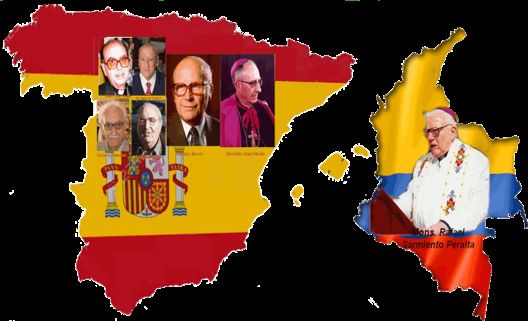
In February 1953, the then priest Rafael Sarmiento Peralta, Episcopal Delegate of Colombian Catholic Action, traveled to Mallorca and participated in Cursillo No. 71. That experience was not simply a spiritual retreat for him, but a true pastoral revelation. He sensed that there was a providential tool there to renew the faith of the laity and evangelize their environments.
He returned to Colombia without plans, without manuals, without literature, and without trained lay teams. He brought with him only the impact of what he had experienced, a bold faith, and an inner certainty: he had to begin. And he began.
With the help of Fathers Manuel Segura, C.M., and Enrique Acosta, he set out to offer the first Cursillos. He took on practically everything himself: spiritual director, rector, and speaker, accompanied only in some meditations. Humanly speaking, it was a reckless undertaking; spiritually, it was fertile ground for Grace.
The “holy heresy”: the first women’s Cursillo in the world
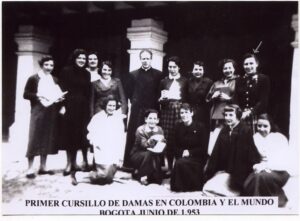
 Aware that this was a completely new experience in Latin America, Father Sarmiento decided to start with young women. Thus, from June 27 to 30, 1953, at the Hacienda Las Mercedes in Zipaquirá, owned by the Villamizar family, the first Cursillo for women in Colombia and the world was held.
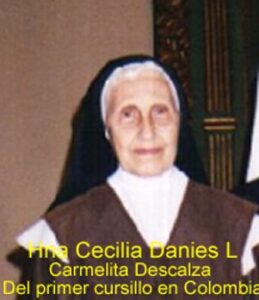
Fifteen young leaders of Catholic Action for Women participated, including its national president, Cecilia Danies Lacouture, along with other women who would later become evangelical leaven in their environments. At a time when Cursillos for women were prohibited in Spain, that experience was a true “holy heresy,” born not of rebellion but of apostolic zeal.
The language, meditations, and outlines were adapted to the psychology of young women. Almost naturally, the Cursillos in Colombia began to take on a marked Marian accent. Mary appeared more strongly in the talks and meditations, especially in the Talk of Grace, presented as a cooperator in the plan of salvation and a model of total availability to God’s will.
The fruits were immediate. Those young women came out transformed, ready to be salt of the earth, light of the world, and leaven of the Gospel in their environments. It was, as many later described it, a true Pentecost.
Expansion and unexpected fruits
Once the experience with women had been tried and tested, the men’s Cursillos arrived. In October 1953, the first Men’s Cursillo was held in Colombia. Among the participants was an 18-year-old psychology student: Alfonso López Trujillo. He himself would later acknowledge that it was during that Cursillo that he discerned his priestly vocation.
His subsequent career—priest, auxiliary bishop of Bogotá, archbishop of Medellín, secretary general of CELAM, cardinal, and president of the Pontifical Council for the Family—cannot be understood without that initial encounter with Christ experienced in a simple Cursillo, imperfect in form but full of grace.
Meanwhile, the Cursillos multiplied. Other dioceses began to request them, and Father Sarmiento traveled throughout the country with tireless dedication. The fruits of his labor enthused bishops and pastors, including the Cardinal Primate of Colombia, who approved, blessed, and gave their decisive support to the Cursillos.
The time of purification and fidelity
 As the years passed, an increasingly clear awareness emerged: the Cursillos in Colombia needed to rediscover their original authenticity. In 1961, Father Manuel Segura, aware of the differences with the Cursillos that were being lived in Spain, contacted Juan Capó, a leader of the Movement in Córdoba.
The arrival of that team marked a turning point. In Medellín, authentic Cursillos were held, Ultreyas were organized, Group Meetings were promoted, and lay leaders were trained. It was not a break, but a purification; not a denial of the past, but its maturation.
From Medellín, the renewal spread to Bogotá and the rest of the country. In December 1964, the First National Gathering of Cursillistas, with nearly a thousand participants from almost all the dioceses, definitively confirmed the authenticity of the Movement in Colombia.
A history that continues to illuminate the present
Years later, Monsignor Sarmiento himself would humbly acknowledge that those first Cursillos had not been “authentic” in the strict sense. But he would also recognize—along with Father Capó—how the Lord used that initial audacity to introduce the charism to America.
Therein lies the greatness of this story: God writes straight with crooked lines. Colombia was a laboratory and a frontier, a risk and an experiment, but also fidelity, ecclesial communion, and apostolic fruitfulness.
Today, the Cursillos de Cristiandad in Colombia are fully authentic. And they are so because they do not deny their origins, but rather are grateful for them. Because they know that the leafy tree that today provides shade and fruit was born from a small seed, sown with faith, watered with sacrifice, and cared for by Grace.
The charism is still alive. And as in 1953, it continues to call for bold hearts, capable of trusting God more than their own securities. Because when the Spirit blows, it always opens new paths.