There are places whose importance in the history of the Cursillo Movement cannot be measured solely by the number of Cursillos held within their borders. Austria is one of them. The history of the Cursillo Movement in this country is also the story of a door that opened in the heart of Europe and that, almost immediately, began to open other doors. Austria welcomed the Cursillo, made it its own, and very soon became a launching pad for other countries.
If this story had a name, it would undoubtedly be that of the Spanish Claretian, Fr. Josef García-Cascales, CMF, born in Xàtiva in 1928. After studying philosophy in Spain and theology in Frankfurt and Würzburg, he spent much of his ministry in Austria. His name would become deeply linked to the development of the MCC in the German-speaking world and, later, to its expansion throughout Central Europe.
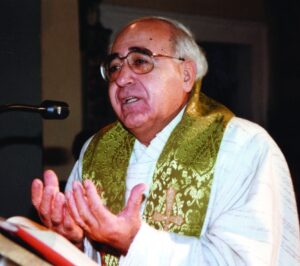 On Pentecost 1960, from June 3 to 6, the first Cursillo de Cristiandad in Austria was held in Heiligenkreuz, Lower Austria, spearheaded by García-Cascales. It also marked the beginning of the Cursillo in the German language. Barely a year had passed when, on October 13, 1961, the first Cursillo for women was also held. The seed had fallen on fertile ground and was beginning to grow rapidly.
But what was truly significant about the Austrian experience was that, practically from the very beginning, it looked beyond its own borders. In 1961, the Austrians, led by García-Cascales, brought the Cursillos to the German diocese of Rottenburg. There, the Ultreya, the School, and the Secretariat gradually emerged. In 1970, the Cursillo also reached South Tyrol, and a few years later, that evangelizing movement began to penetrate a much more challenging reality: the Europe located on the other side of the so-called Iron Curtain.
Austria thus became one of the MCC’s major bridges to Central and Eastern Europe. In 1974, the Cursillos began in Croatia—then part of Yugoslavia—under the direction of Father Andrija Vrane. The Movement’s historical records explicitly refer to Austria as the country that “sponsored” the Cursillos in Germany and Yugoslavia and later collaborated in their spread to other countries within the Soviet sphere of influence. It was not merely a matter of spreading a methodology. In those political and social contexts, keeping alive an experience of evangelization, community, and lay leadership presented challenges that we can better understand today by looking back at that divided Europe.
As that expansion continued, the Austrian MCC was also consolidating internally. Austria very soon had one of the first magazines dedicated to Cursillos, translated texts, produced its own publications, and carried out important work to adapt the movement to the Germanic cultural and linguistic context. García-Cascales would devote practically his entire life to this mission and would remain involved in the leadership of the Austrian Movement until 2003.
This maturity also gave Austria considerable influence within the MCC’s international organization. When the European Working Group began to take shape—initially comprising Spain, Portugal, Italy, Germany, Austria, England, and Ireland—the Austrian National Secretariat was elected coordinator of the Group. Vienna would also serve as the venue on several occasions for European meetings—including those in 1983, 1991, 1999, and 2013—carrying forward that spirit of encounter and bridge-building that had characterized the Austrian MCC since its early years.
A building also remained as a visible sign of that journey. In 1975–1976, thanks to contributions from the Cursillistas and the Archdiocese of Vienna, Haus Claret was built on Bennogasse in Vienna, becoming the headquarters of the Austrian National Secretariat and the Diocesan Secretariat of Vienna. There, in a sense, was symbolized a history built by priests and laypeople who understood that what they had received could not remain confined within four walls.
On Pentecost 2010, fifty years after that first Cursillo, the Movement celebrated its half-century of presence in Austria at the Abbey of Kremsmünster. The chosen motto was particularly evocative: “Wir – Christen der Zukunft,” “We, Christians of the Future.” Fifty years later, that small seed planted in Heiligenkreuz had crossed borders, languages, and even political systems.
Today, the Cursillo remains active in Austria, with secretariats and groups in various dioceses. But perhaps its historical contribution to the worldwide MCC lies, above all, in that ability to serve as a bridge. Austria demonstrates that the true expansion of the Movement has never simply consisted of adding countries to a map. It consists of people who discover the joy of the Gospel and feel that what they have received does not belong solely to them.
That is why, when we look at the history of the MCC in Austria, we discover something deeply connected to our own pilgrim identity. Someone brought an experience there; others welcomed it, made it part of their lives, translated it into their culture, and then set out once more to pass it on to others. From Austria to Germany; from there to Yugoslavia and other countries in Central and Eastern Europe. A chain of friendship, witness, and evangelization that was even able to cross the Iron Curtain.
Perhaps that is the image that best sums up this entire story: Austria was not merely a land of arrival for the MCC. It was, above all, a land of departure.