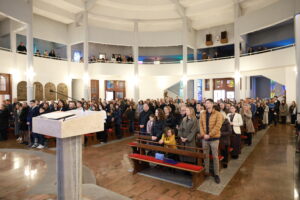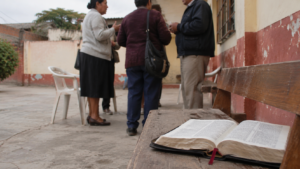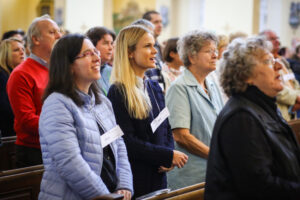

On 22 November 2026, in Saint Peter’s Square, on the Solemnity of Our Lord Jesus Christ, King of the Universe, Pope Leo XIV offered a concrete vision of God’s Kingdom. Drawing on Matthew 25:31-46, he did not speak of distant power, but of Christ who sheds light on human relationships and draws near to those who suffer. For Cursillo members, his words place evangelization in the midst of life: wherever bread is shared, newcomers are welcomed and each person’s dignity is upheld.
The Pope’s words
Leo XIV states that “Christ is the measure of justice because he is the author of salvation.” This is not an abstract claim. The Pope unfolds the Gospel passage through realities we immediately recognize: hunger, being a stranger, lacking clothing and being deprived of freedom. In them, he says, justice “sustains life,” establishes “bonds of fraternity among peoples,” upholds human dignity and restores freedom.
The key point is decisive. The Lord is not “a despot who threatens nor a tyrant who crushes others with his power.” His kingship is that of the One who redeems. Christ, the “Master of humanity,” lifts people from the dust of passing time and calls them to new life. For this reason, God’s judgment is not a threat meant to paralyse us; “this judgment is, in fact, salvation,” because the word God addresses to the world is a proclamation of mercy.
At the same time, this mercy is never indifferent to evil. The Pope recalls Jesus’ words: “Just as you did not do it to one of the least of these, you did not do it to me.” Christ the King stands alongside the least and the oppressed in order to redeem them from all evil. Faith, then, is not confined to a private conviction: it becomes visible in how we look at, listen to and accompany others.
A call to evangelization
Christian proclamation begins with the Good News that God loves and saves us in Jesus Christ. That proclamation becomes credible when it reveals the style of the One we proclaim. In Leo XIV’s teaching, the justice of the Kingdom takes shape in actions that enable others to live: feeding, welcoming, clothing and visiting.
For the Cursillo Movement, this perspective is an invitation not to separate the initial proclamation from friendship and witness. Evangelizing environments does not mean imposing religious discourse. It means bringing into them a presence transformed by Christ: a presence that refuses to normalize loneliness, exclusion, corruption or contempt. Christian friendship can open places where someone is heard without being reduced to a problem, where a family finds support and where reconciliation becomes possible.
Not every need calls for the same response, and no Cursillo member can resolve every injustice alone. Yet none of us is exempt from recognizing a call in such situations. At times that call may be to share time; at others, to join an initiative of the Church or the community; and at others, to review our own relationships and choices. Mission grows when it lets itself be challenged by particular people.
For our life as Cursillo members
Matthew’s Gospel does not first ask for impressive achievements, but for love made flesh. It is worth carrying this question into our own environments: who today needs a welcome they have not found? Who has been left on the margins of family, work or community? Which relationship needs more truth, patience or mercy?
The Pope reminds us that we are all equal before God’s law. This corrects the temptation to classify people according to usefulness, prestige, origin or closeness to our own ideas. A Cursillo member is called to recognize the other as a brother or sister before seeing them as an opponent, the object of an agenda or merely someone to assist. Closeness does not replace justice; it gives justice a face and makes it practicable.
Celebrating Christ the King at the close of the liturgical year also renews our hope. The Kingdom is coming and will endure forever, even as our communities experience fragility and the world is marked by conflict. Therefore, small acts of fraternity are not insignificant: in a humble yet real way, they point to the King who does not abandon his people.
Conclusion
Christ’s kingship is measured not by domination, but by a mercy that lifts up and unites. This week, we can ask for the grace to recognize him in the least among us and to make each environment a little more habitable. Wherever a life is sustained, welcomed and defended, the Kingdom is already becoming visible.