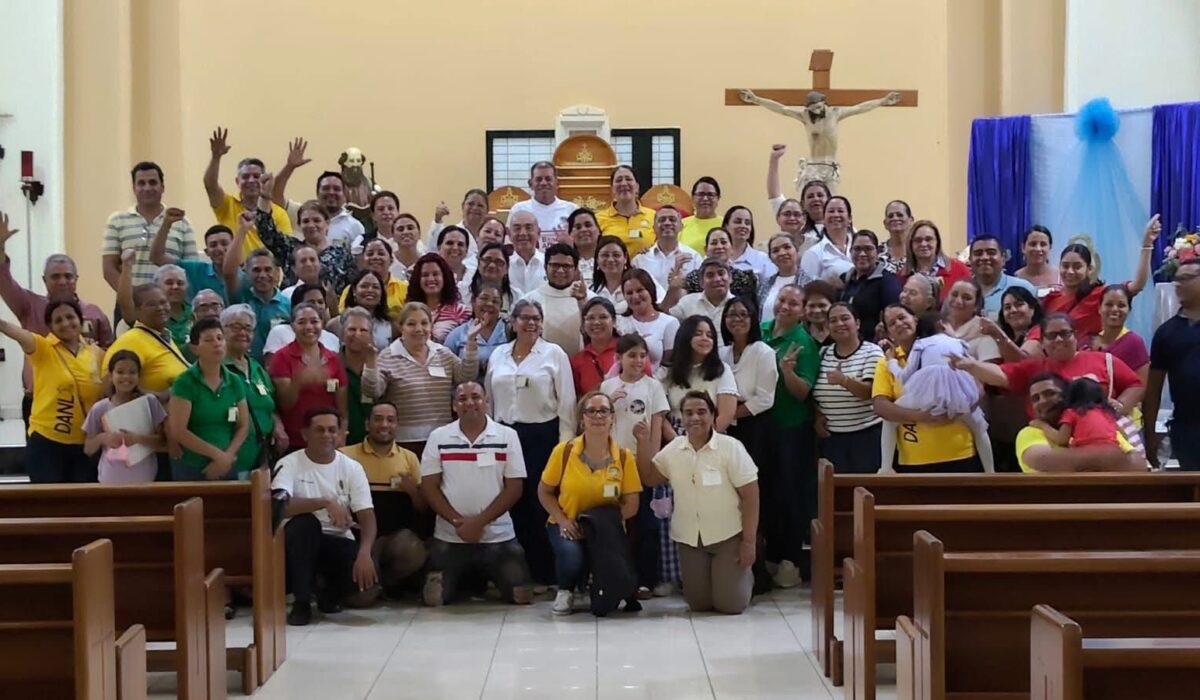
 The history of the Cursillos in Christianity Movement in Honduras is, above all, a story of grace poured out, of hearts touched by Christ, and of a Church that allowed itself to be renewed from within. It was not born out of improvisation or passing enthusiasm, but out of a profound encounter with the living Jesus, who transforms people and, through them, their environments.
It was 1964 when the Spirit began to make a concrete way in our land. The then Archbishop of Tegucigalpa, Monsignor Héctor Enrique Santos, moved by the desire for a more alive and committed Church, first wanted to personally experience the Cursillo. After doing so in El Salvador, he understood that this simple and deeply evangelical method could be an answer for Honduras. Thus, with pastoral humility and missionary vision, he promoted the first steps of the MCC in the country.
The first Cursillo for men in Tegucigalpa, held in October 1964, was a true sowing of seeds. Those first brothers, fresh from their encounter with Christ, returned changed: filled with joy, shared faith, and a contagious apostolic zeal. Women’s courses soon followed, and the Movement began to take shape as a path of conversion and commitment, always in communion with the Church and under the close guidance of bishops and priests.
From Tegucigalpa, the MCC spread like a gentle but steady fire. It reached San Pedro Sula, La Ceiba, Comayagua, Olancho, Danlí, El Paraíso, Tela, and many other communities, adapting to diverse realities, including cultural and linguistic ones, as was the case in Sangrelaya, where the message was also proclaimed in the Garifuna language.
In each place, the same miracle was repeated: men and women encountering Christ, reconciling themselves with the Church, and discovering their lay vocation in the world. The fruits were soon visible.
 At a time when many men were distant from church life, the Cursillistas began to occupy the front pews, to receive Communion with joy, to pray without fear, and to speak naturally about their friendship with Christ. The MCC thus became an evangelical leaven, rejuvenating parishes, encouraging other movements, and awakening vocations to service, both in the Church and in society.
But the road was not without difficulties. There were moments of fatigue, misunderstandings, and stumbles. However, the Lord’s help and the silent fidelity of so many Cursillistas who, from their fourth day on, continued to walk “beyond,” sustained by prayer, the group, and the ultreya, were never lacking. That perseverance is perhaps one of the most beautiful features of the history of the MCC in Honduras.
Today, when we look back, we do so not to dwell in nostalgia, but to give thanks. To thank God for so much life given, for the priests, bishops, and laity who made their lives a permanent Cursillo; and to renew the awareness that this story is still open. The Cursillo Movement in Honduras continues to be a living call to encounter Christ, to live the fundamentals of Christianity, and to transform our surroundings with the joy of the Gospel.
Because the story is not over. It continues to be written every day, in every cursillista who, with simplicity and hope, dares to say with their life: De colores!