In 1962, the Cursillo Movement of Christianity found in Brazil a particularly fertile land for its expansion. In a historical context in which large sectors of the world were living distant from God, the MCC affirmed itself as an effective method for leading people toward an authentic spiritual conversion, through its own method of a kerygmatic and testimonial character.
This method fosters a triple encounter: with oneself, with Christ, and with the community, generating bonds of Christian friendship that inspire people to lead others to friendship with Christ, orienting their lives toward the Kingdom of God and eternity.
EXPANSION OF THE MCC OUTSIDE SPAIN
Before its arrival in Brazil, the Cursillo Movement of Christianity was established in Colombia, in South America, through Catholic Action. In that country, not only was the first Cursillo outside Spain celebrated, but also the first Cursillo for Women, in 1953, marking a fundamental milestone in the international expansion of the Movement.
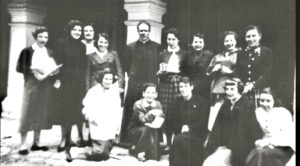
First Cursillo for Women – Colombia – February 1953.
VALINHOS, WHERE IT ALL BEGAN
There are stories that begin in a whisper, almost unnoticed, and over time become a great and colorful song. Thus began the history of the Cursillo Movement of Christianity in Brazil, in a year that did not seem destined for major headlines but nonetheless marked a before and after in the spiritual life of the country.
The first Cursillo was celebrated during Holy Week, from April 18 (Wednesday) to April 21 (Saturday), 1962, in a manor house of the São Joaquim Farm (Valinhos, São Paulo).
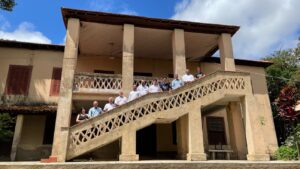
Staircase of the São Joaquim House, where the first Cursillo for men in Brazil took place.
In the quiet city of Valinhos, a small group of men gathered to live what would become the first Brazilian Cursillo. No one yet knew what would come of it, how much it could grow, or how many lives it would touch. They only knew that something special was about to be born—and so it was.
During those days, amid sincere conversations, moments of silence, shared prayers, and unexpected personal discoveries, a work began to take shape that, over the years, would spread throughout Brazil like a river opening its way until it becomes the sea.
From that first encounter, one thing became clear: the spirituality of the MCC naturally resonated with the Brazilian heart. The country was living a vibrant period of pastoral initiatives, liturgical renewal, new forms of lay participation, and profound searches within the Church.
It is worth noting that the Catholic world was on the eve of the opening of the Second Vatican Council, convened by Pope John XXIII on October 11, 1962.
Brazil was on the move, thirsting for apostolic paths that united personal experience with community life. It was precisely in this fertile ground that the MCC found not only acceptance, but a home.
Therefore, the Movement did not take long to expand. Communities began to hear about what had happened in Valinhos, were infected by the enthusiasm, and soon began requesting Cursillos in other cities. What began as a small local initiative almost imperceptibly became a growth process that no one could stop.
After the Cursillo in Valinhos, the second Cursillo took place in Mogi das Cruzes, also in the state of São Paulo, and subsequently spread throughout Brazil.
FIRST ECCLESIASTICAL ADVISORS OF THE MCC – BRAZIL
Amid this growth emerged a figure who would become one of the great protagonists of the history of the MCC in Brazil: Father Paulo Cañelles. His presence marked an era. Those who knew him remember him as a tireless priest, full of apostolic zeal, with an extraordinary ability to inspire, accompany, and ignite hearts.
He was not merely an organizer or administrator; he was an authentic apostle—someone who deeply believed that the Gospel could transform each person’s life, and who saw in the Cursillos a real path to achieve this.
Thanks to his dedication, constant travels, encounters with ordinary people and ecclesial leaders, the MCC in Brazil received a decisive impulse. Under his guidance, the Movement grew not only in numbers, but also in spirit, identity, and clarity of mission.
After the tragic automobile accident that claimed the life of Father Paulo Cañelles in 1973, another priest deeply dedicated to the MCC, Father José Gilberto Beraldo, continued the mission of the Cursillo in Brazil.
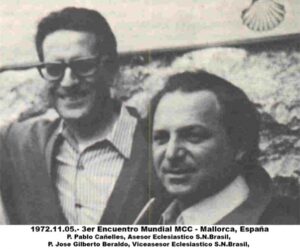
P. Paulo Cañelles y P. José Gilberto Beraldo
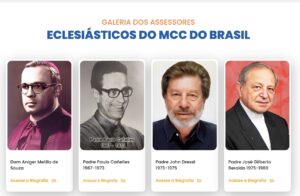
First ecclesiastical advisors of the MCC in Brazil
CANONICAL RECOGNITION AD EXPERIMENTUM OF THE OMCC STATUTES (2004)
In 2022, Brazil assumed the worldwide coordination of the OMCC, integrating the following Committee: Fr. José Gilberto Beraldo (World Spiritual Advisor), Francisco Alberto Coutinho (President), Antônio Carlos Salomão – Tony (Vice President), and Maria Elisa Zanellato (Secretary).
During this mandate, Fr. José Gilberto Beraldo carried out a significant work in service of the approval (ad experimentum) of the OMCC Statutes by the then Pontifical Council for the Laity (Pontificium Consilium Pro Laicis), today the Dicastery for the Laity, the Family and Life.
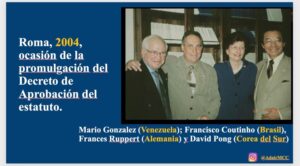
Rome – 2004
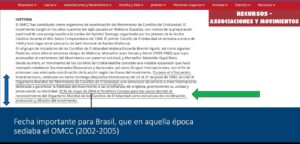
Vatican website registering the acceptance of the OMCC Statutes presented by Brazil in 2004.
Father Beraldo traveled throughout the world in service of the OMCC, establishing contact with all Cursillo leaders and with the ecclesial authorities of the Movement.
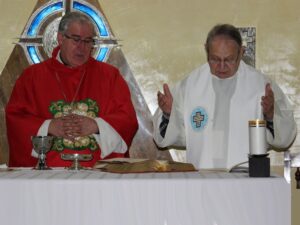
Monsignor José Ángel Saiz Meneses and Father José Gilberto Beraldo
NEW PARTICIPATION OF BRAZIL IN THE OMCC
Brazil once again became part of the global service structure of the Cursillo Movement of Christianity following the OMCC elections held in Monterrey, Mexico, in 2023.
In this worldwide MCC election, Brazil returned to serving the OMCC with the election of Dr. Adair J. Batista as World Vice President, alongside Dr. Álvaro M. Moreno, current World President, thus strengthening communion and collaboration among countries and consolidating the historical connection between Spain and Brazil.
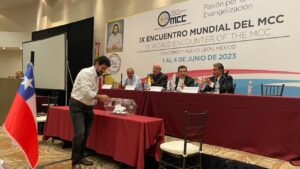
Adair – OMCC Elections, Monterrey, Mexico 2023
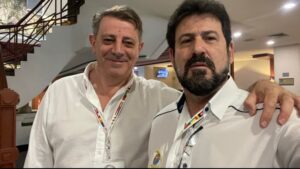
OMCC connection 2023–2027: Spain (Álvaro) and Brazil (Adair).
THE LARGEST CATHOLIC COUNTRY IN THE WORLD
Brazil is a country of continental dimensions and also the country with the largest number of Catholics in the world. Currently, the Catholic Church in Brazil has 488 living bishops, of whom 316 are in active pastoral ministry and 172 are emeritus bishops, who continue collaborating in the Church’s evangelizing mission.
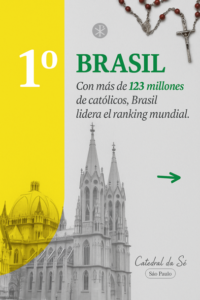
According to the Vatican Pontifical Yearbook, Brazil has the largest Catholic population in the world, followed by Mexico.
NUMBER OF CURSILLOS HELD ANNUALLY IN BRAZIL
According to estimates based on the Brazilian reality, approximately four (4) Cursillos per diocese are held each year, with an average participation of 40 people per Cursillo, considering an approximate total of 150 dioceses.
In this context, it is estimated that around 600 Cursillos are held annually in Brazil, representing approximately 24,000 new cursillistas per year.
Behind these impressive numbers lies a multitude of human stories: strengthened marriages, young people discovering their vocation, workers bringing the Gospel to their workplaces, priests renewing their pastoral enthusiasm, and entire communities regaining hope. The expansion of the MCC in Brazil is, ultimately, the expansion of grace acting in everyday life.

Annual estimate of courses in Brazil
CURSILLO FOR YOUTH
The Youth Cursillo is an integral part of the history and life of the Cursillo Movement of Christianity in Brazil, in continuity with its charism, method, and purpose.
In 1985, in the Archdiocese of Olinda and Recife, the then Archbishop Dom Hélder Câmara authorized, ad experimentum, the celebration of the first Youth Cursillo in Brazil. This pastoral authorization responded to the Church’s discernment regarding the challenges of youth evangelization and was granted in full ecclesial communion and fidelity to the original charism of the MCC.
This experience did not give rise to a distinct or autonomous movement, but rather constituted a pastoral application of the same Cursillo Movement of Christianity, carried out with the participation and accompaniment of adult leaders, in accordance with the structure, methodology, and identity of the MCC.
The ad experimentum authorization of Youth Cursillos did not represent a rupture, but a legitimate adaptation of language and dynamics to the youth context, fully respecting the charism, method, purpose, and identity of the Movement.
From this initial experience in Olinda–Recife, the Youth Cursillo progressively spread to other dioceses in Brazil, always under the guidance of the respective Secretariats and the accompaniment of local bishops, in communion with the Church and fidelity to the charism of the Cursillo Movement of Christianity.
Thus, the Youth Cursillo in Brazil is consolidated (existing for 40 years) and acts as a factor of expansion of the Movement, with an active presence over the last four decades.
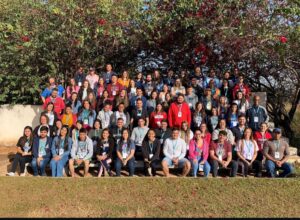
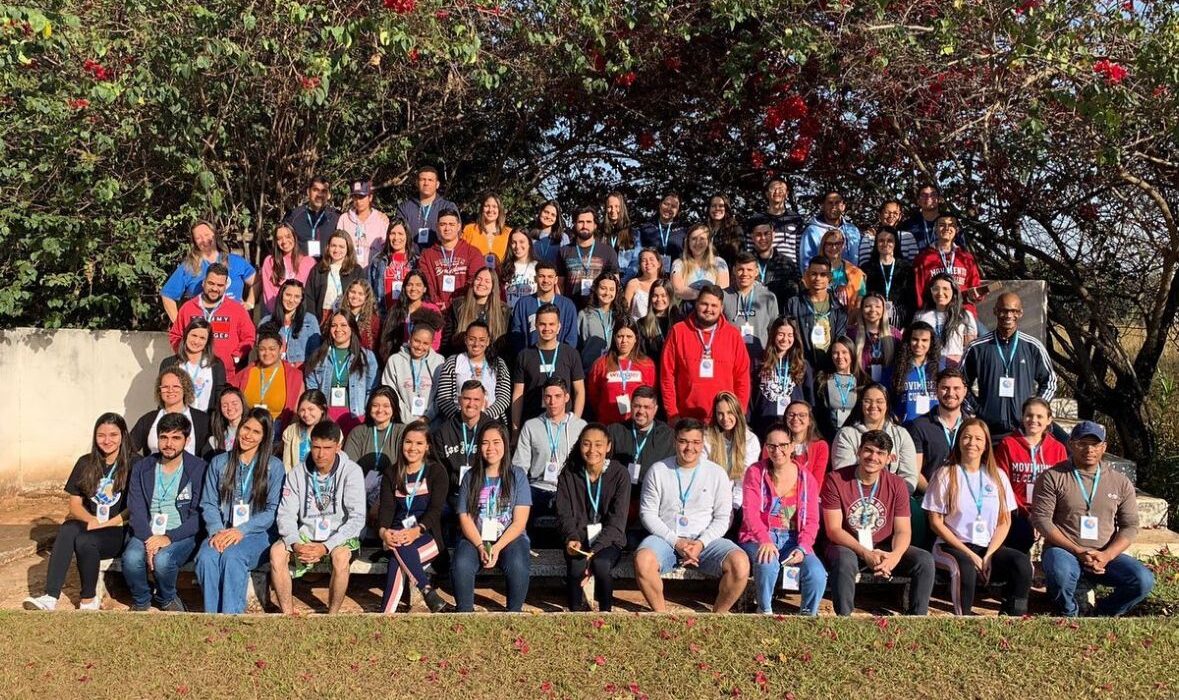
Cursillo for young people, Diocese of Uberlândia, MG – Brazil
The Youth Cursillos are always supervised by adult leaders and priests (spiritual directors).
It is worth noting that the Cursillo Movement of Christianity in Brazil maintains a permanent commitment to the continuity of the Movement. With this objective, over the past forty years it has sought to develop mechanisms that foster renewal and continuity, facilitating the succession of leaders at all levels, through creative fidelity, in accordance with IF3 Ed., §61.
These actions are carried out unequivocally in respect for the original charism, mentality, method, and purpose of the Movement, as established in IF3 Ed., §58.
From that first Cursillo in Valinhos (1962) to the present day, this history has been written through Ultreya embraces, friendship groups sustained across distances, leaders who generously give their time, and communities that continue to believe that the Gospel can change everything.
And the most beautiful part is that the story is not finished. It remains open, under construction, waiting for new protagonists.
De Colores and viva la vida!
Adair J. Batista (15 December 2025)