The adventure of the Cursillos in Christianity Movement in Chile, from its earliest beginnings to the southernmost tip of the country.
The history of the Cursillos in Christianity Movement in Chile does not begin with an official date or a solemn decree, but—like so many works of the Spirit—in a discreet, almost silent way, sprinkled with personal encounters, prolonged waiting, and a hope that refused to disappear.
First seeds: before there were Cursillos
Although the first visible manifestations of the MCC in Chile date back to around 1960, when some cursillistas—mostly foreigners—who had lived the experience in other countries began to appear, there is an even earlier and deeply significant precedent.
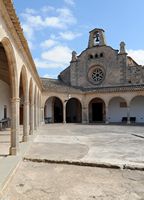 In 1950, the magazine Proa, the official organ of the Cursillos de Mallorca, published an interview with Francisco Fluxá Ginart, a young Chilean of Mallorcan descent who, during a visit to the land of his roots, was invited almost casually to experience a Cursillo. His faith was rather indifferent, but that experience—Cursillo No. 30 in Mallorca, held in March 1950 at the Montesión de Porreras Shrine—would mark a turning point in his life. Without knowing it, Francisco Fluxá would become the first known Chilean to experience a Cursillo de Cristiandad, many years before the Movement took formal root in his homeland.
The prehistory: prayer, waiting, and perseverance
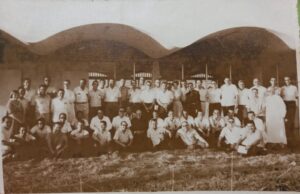
In the early 1960s, in Santiago, several foreign Cursillistas began to meet, motivated by nostalgia for the atmosphere they had experienced in their respective countries. Priests and lay people—Dutch, Spanish, Bolivian—shared groups, friendship, and prayer, dreaming that one day Cursillos could officially be born in Chile.
Among them were names such as Father Edmundo Hammerlink, Father Francisco Vicente, married couples such as the Grecianos and the Moratinos, and other committed lay people. With humility and perseverance, they approached the then Archbishop of Santiago, Cardinal Raúl Silva Henríquez, requesting authorization to start the Cursillos. However, doubts about a methodology considered “very Spanish” and certain prejudices typical of anything new delayed approval.
These were years of sorrow, prayer, and hope, a true prehistory of the Chilean MCC, in which the Spirit seemed to work silently, preparing the ground.
Temuco 1963: the official birth
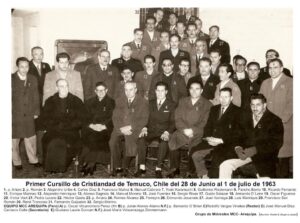 History would change decisively in 1963, in the diocese of Temuco, under the pastoral care of Bishop Bernardino Piñera. In the context of a Great Diocesan Mission, the need arose to form and motivate the laity for active and committed participation.
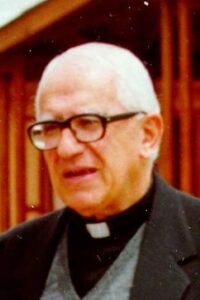
It was then that Father Arturo Dwyer, a Maryknoll missionary and pastor of Santo Tomás, proposed introducing the Cursillos de Cristiandad as a method of conversion and spiritual formation. With the boldness of one who trusts in the Spirit, Father Dwyer not only proposed the idea, but also offered to bring a team from Arequipa, Peru, where he himself had lived the experience.
 With the bishop’s approval, between June 28 and July 1, 1963, the First Cursillo de Cristiandad in Chile was held in Temuco.
Thus began officially this story of grace on Chilean soil.
Growth, discernment, and purification
During the following years, the MCC began to expand throughout various dioceses in the country, initially accompanied by the Peruvian team. Meanwhile, in Santiago, a different experience was taking place, marked by the influence of Gerino Casal, who introduced his own style of “special Cursillos,” authorized in 1964.
However, over time, many leaders began to contrast this experience with the methodology that was being developed in other dioceses, especially in Temuco. After dialogue, discernment, and ecclesial communion, they came to the conclusion that it was necessary to align themselves with the authentic method of the MCC, as it had been conceived and lived in the Church.
This process culminated in 1969 when, after a positive evaluation by a priest sent by Cardinal Silva Henríquez to Temuco, the MCC was officially authorized to begin in Santiago according to the regular method. Between April 30 and May 3, 1969, the first “authentic” Cursillo for men was held, followed months later by the first for women.
A Movement at the service of the Church
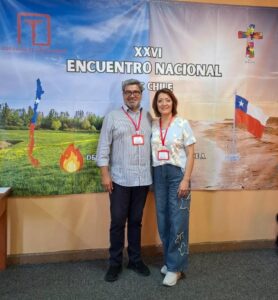 In 1969, during the Second National Meeting in Concepción, the first National Secretariat was established, a sign of maturity and communion. Since then, the MCC in Chile has continued to walk as an ecclesial Movement, at the service of the Church, faithful to its charism and attentive to the signs of the times.
The history of the MCC in Chile is, in short, a history of patience, fidelity, and docility to the Spirit, which knew how to wait when necessary, correct the course when needed, and move forward with joy when doors opened.
It is a history that continues to be written today, in each Cursillista who discovers the fundamentals of Christianity and brings them to life in their own environments.